
📊 Your AI Wrapped 2025
How much did you use AI in 2025, and what for? 🤔

Inspired by the virality of Spotify Wrapped 🎵, as the year comes to an end it’s worth asking a similar question about AI: How much have we used it in 2025, and more importantly, what have we used it for? 🎯

Both at a personal level and within organizations, usage patterns say a lot about real adoption versus experimentation. In this article, I explain how to analyze your own AI usage and how organizations should measure it, using the right KPI’s and relevant benchmarks.
🙋♀️ Personal AI Wrapped
To start, I ran this exercise myself to understand how I’ve actually used ChatGPT on a personal level throughout the year.
You can do the same with your own data: just go to Settings → Data controls → Export data, and then ask ChatGPT to analyze the file and generate usage statistics.
Here’s what came out 👇
Intensity and depth of use
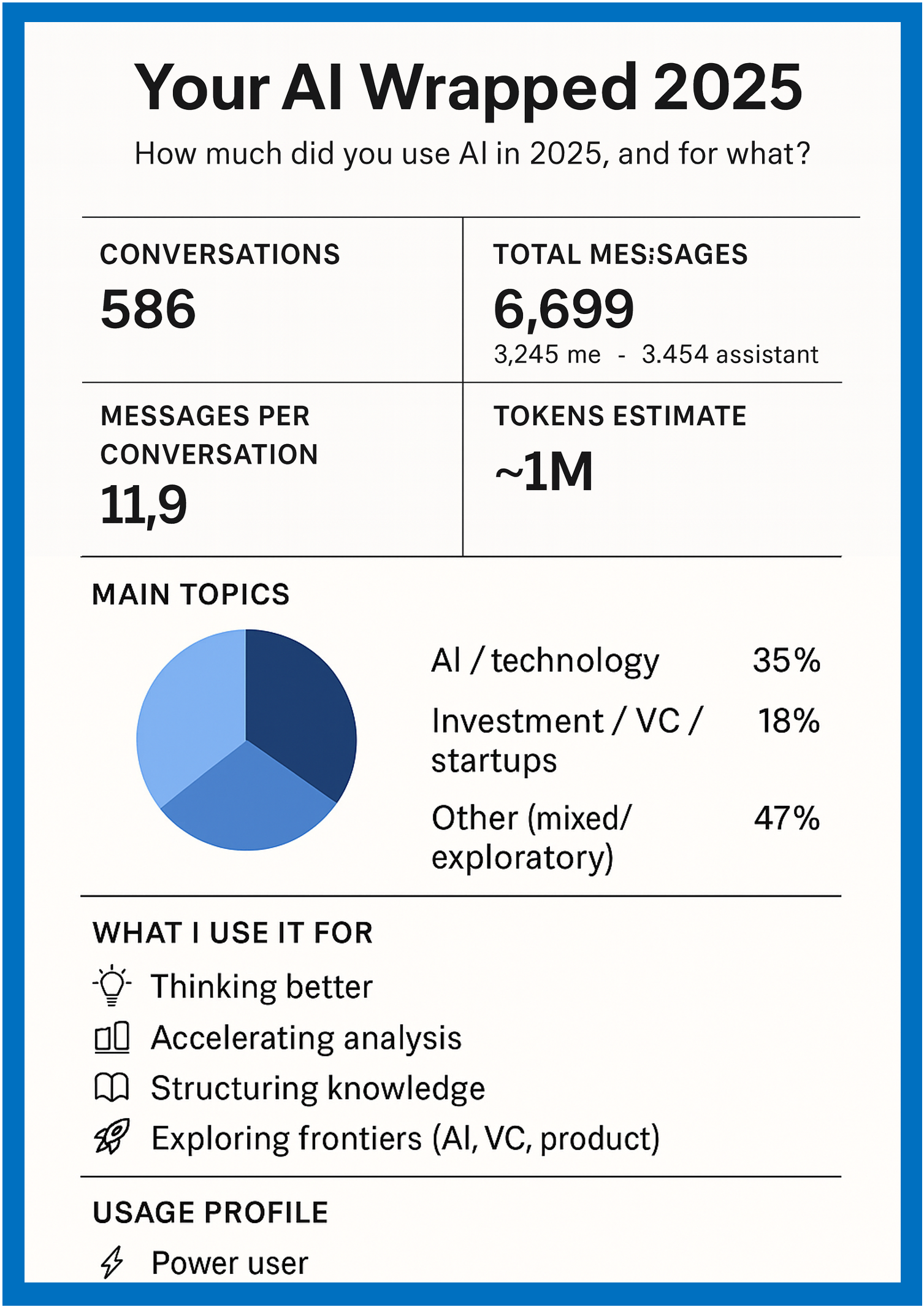
586 conversations initiated
6,699 total messages (11.9 messages per conversation)
🧠 3,245 from me
🤖 3,454 from the assistant
Intellectual output
✍️ Words written by me: 121,537 (~160k input tokens)
🧾 Words generated: 604,585 (~800k output tokens)
🔁 Output / input ratio~5x
~1M total tokens in 2025
Main themes
🤖 AI / technology: 35%
💼 Investment / VC / startups: 18%
🧩 Other (mixed / exploratory): 47%
The “Other” category includes: brainstorming, strategic synthesis, idea exploration, content preparation ✨
Usage pattern
What I use it for
Thinking better
Accelerating analysis
Structuring knowledge
Exploring frontiers
What doesn’t appear
Almost no usage for: emotional support, trivial queries, entertainment
Very limited use for: travel, leisure, household tasks
(arguably an area where I should use it more 😅)
Some conclusions
I don’t use ChatGPT as a search engine or a simple Q&A tool, but as a intellectual copilot. ChatGPT helps me amplify thinking. Every idea I introduce is expanded into structured material, iterative, contextual, and progressively refined. Compared with benchmarks, ChatGPT defines me as a power user, with a deliberate and consistent usage and with a profile of an advance knowledge worker.
Measuring and analyzing your AI usage makes you more conscious of how you use it and where you can be more intentional going forward.
In my case, the next step is to have a broader use of deep research, create and feed more living projects to compound thinking on recurring topics, and experiment further with Agent mode to automatize more routine tasks.
💡🏢 What about your organization
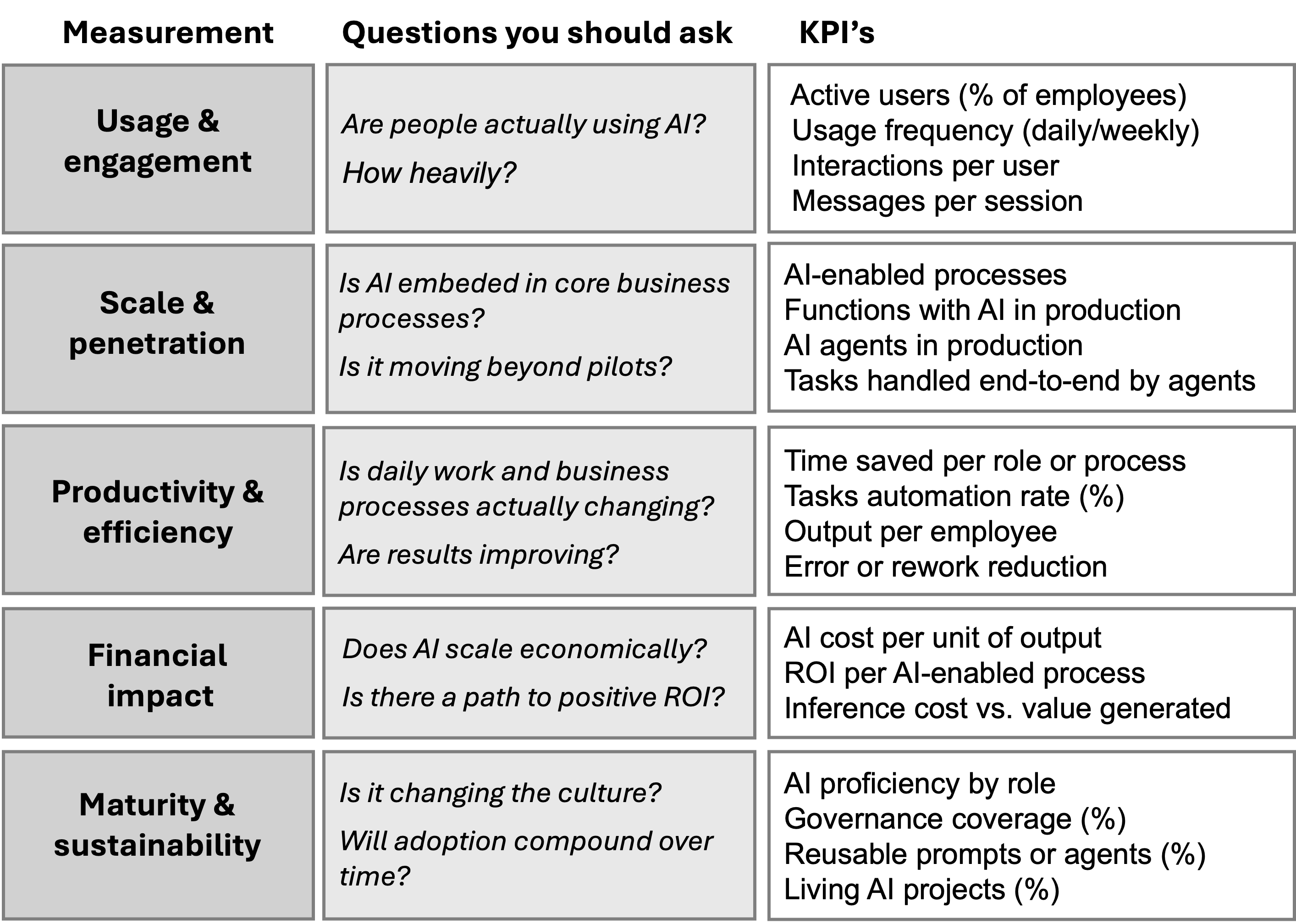
Most organizations still measure AI adoption through pilots and licenses. But the real signal is in scaled usage patterns.
Here some questions you should ask to analyze your company AI Adoption and some KPI’s you should start measuring:
I take the opportunity to share an hilarious post on X that jokes about the impact of rolling out Microsoft Copilot to 4.000 employees, almost no usage but he gets promoted for driving AI adoption 🤣🤣
Jokes aside, it’s increasingly important to measure a responsible AI usage within organizations, and some software tools are already helping organizations to track these metrics.
For engineering teams in particular, the developer productivity platform, DX, has added a. full suite of capabilities to track and boost developers’ AI usage. DX was recently acquired by Atlassian for $1 billion, showing how strategically important AI adoption and productivity measurement have become.
Collecting the data is only the first step. Once you have it, you can track how it evolves over time and benchmark it against industry standards.
To do so, it’s interesting to look a some reports on industry AI Adoption. For example, looking at AI Agents, according to McKinsey’s The State of AI 2025, a growing number of companies are experimenting and piloting with AI agents across functions, most notably in knowledge management (26%), marketing and sales (24%), and IT (23%). However, Agent usage is not yet widespread: among organizations that say they are scaling AI agents, most are doing so in only one or two functions. In fact, less than 10% of respondents say their organizations report scaling AI agents in any given business function.
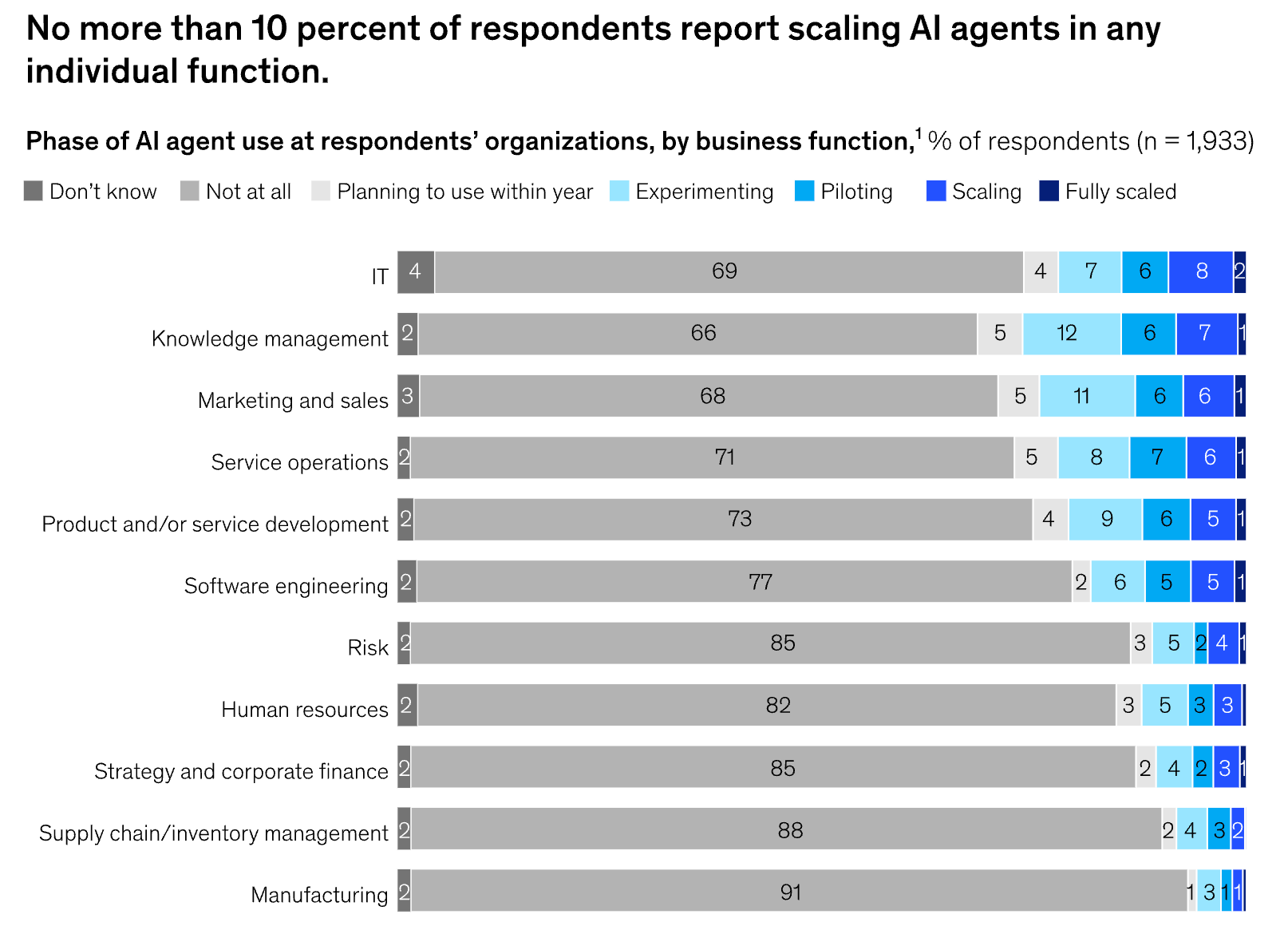
What about your organization? Have you started deploying AI Agents? in which functions?
Another interesting data point is IMD 2025 AI Maturity Index, which assesses how effectively organizations leverage AI, across five key dimensions:
(1) executive support,
(2) technology and infrastructure,
(3) operational excellence,
(4) workforce development and culture, and
(5) ethics and risk management.
In the 2025 ranking, top positions are held by companies such as NVIDIA, Microsoft, and Alphabet. It’s also notable to see SAP ranked #6, Accenture at #15, Deutsche Telekom at #17, AstraZeneca at #23, and Volkswagen at #25.
This is just one ranking, but it’s a useful reference point: knowing who leads AI adoption in your sector helps identify best practices and provides concrete evidence to align and convince management of the strategic importance of AI.
Final thoughts
Counting AI tokens isn’t about vanity. It’s about understanding whether AI is peripheral or central to how you think and work.
So ask yourself: How much have you used AI in 2025? 🤔
If you haven’t looked at your own AI Wrapped yet, you probably should. I encourage you to download your data form ChatGPT, Gemini, Claude or the AI model you use the most.
Curious to know your stats! 🧐